Why Daily Math Practice Works: The Forgetting Curve Explained
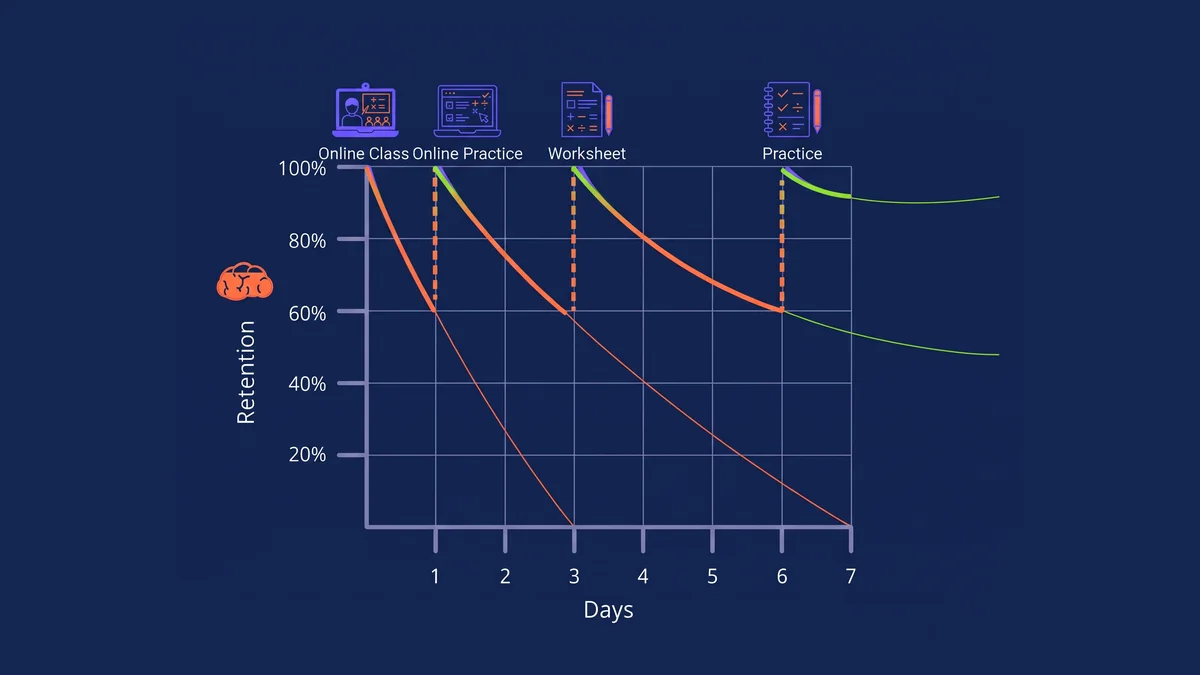
Your child understood it perfectly in class. Two days later, they can't remember how to start the problem. This isn't laziness or a lack of ability. It's how human memory works, and it's the main reason short daily math practice beats one long session a week.
A math skill learned on Monday and not used again until Sunday has to be partly relearned. A skill practised for ten minutes every day doesn't.
The forgetting curve
In the 1880s, the German psychologist Hermann Ebbinghaus measured how quickly he forgot lists he had memorised. He found that forgetting is steepest soon after learning, in the first hours and days, and then slows down. This pattern, the forgetting curve, has been replicated many times since, including a careful modern replication published in 2015 (Murre & Dros).
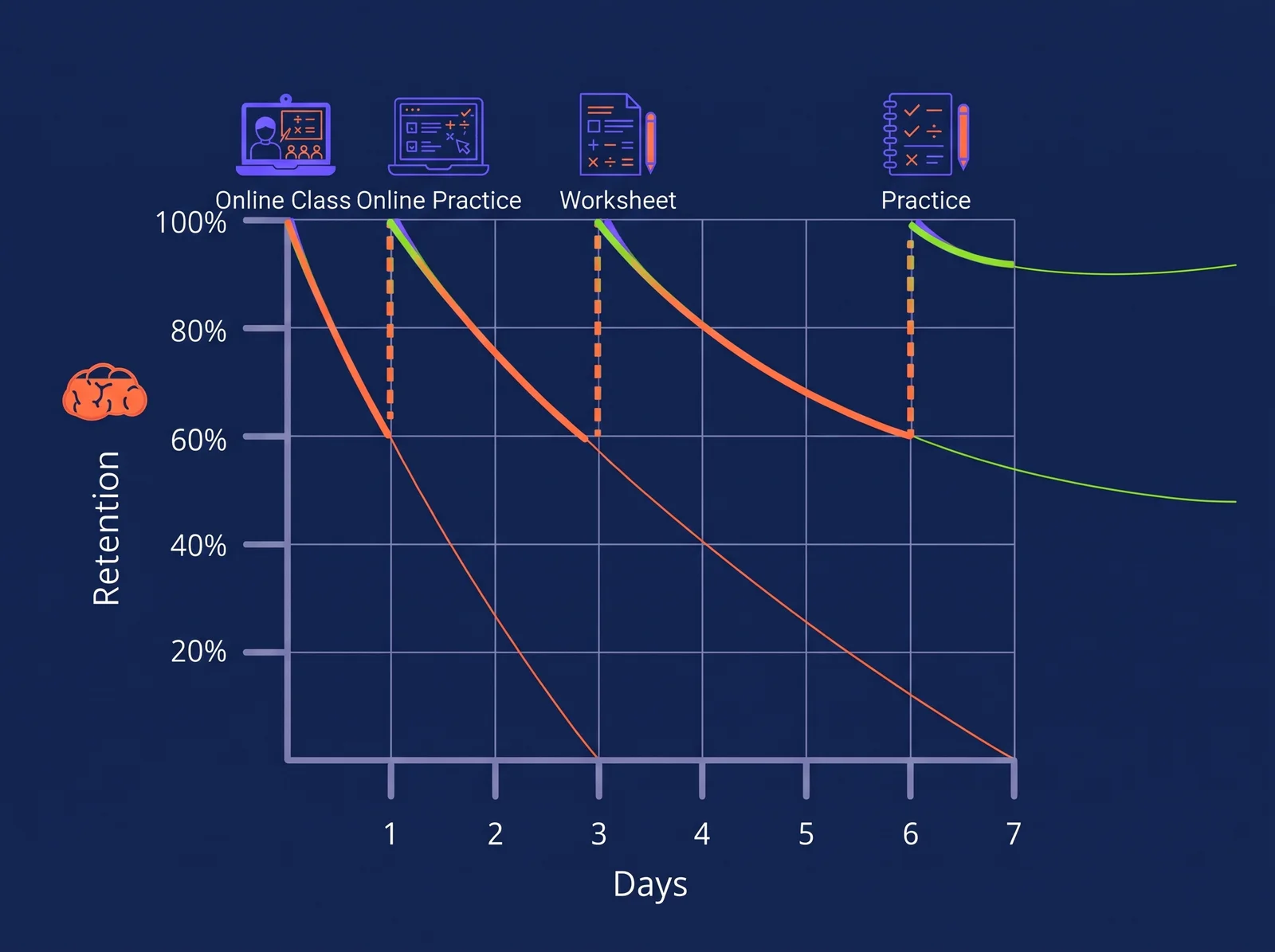
The chart shows two things that matter for parents:
- Without review, a new skill drops quickly. The steepest loss happens in the first day or two.
- Each practice session resets the curve and flattens it. After a few well-timed reviews, the skill fades far more slowly. What once lasted hours starts to last days, then weeks.
Psychologists call the second effect the spacing effect: the same amount of practice, spread out over time, is remembered much better than practice crammed into one sitting.
What the research shows for math
The spacing effect isn't just a lab curiosity. It has been tested directly on math.
Spacing. In a 2007 study by Doug Rohrer and Kelli Taylor, students learned a new type of math problem. One group did all their practice problems in a single session. Another group did the same number of problems, split across two sessions a week apart. On a test one week later, the spaced group scored 74%, compared with 49% for the group that crammed. Both groups did the same number of problems. The only difference was the timing.
Mixing problem types. In the same paper, a second experiment compared practice sets where problems were grouped by type (all of one kind, then all of the next) with sets where different types were mixed together. During practice, the grouped sets felt easier. But on a test a week later, students who had practised mixed problems scored 63%, compared with 20% for students who had practised them grouped: more than three times higher. Mixed practice forces students to work out which method fits each problem, which is exactly what tests ask them to do.
The big picture. In 2013, John Dunlosky and colleagues reviewed hundreds of studies on ten popular study techniques. Only two were rated "high utility": practice testing and distributed (spaced) practice. Rereading notes and highlighting were rated low.
Spreading practice out is one of the best-supported findings in learning science. Students remember more from the same amount of practice when it is spread out than when it is crammed into one sitting.
Why math suffers more from forgetting
Forgetting affects every subject, but math is hit harder, for three reasons.
- Math is a ladder. In history, forgetting one era doesn't stop you understanding the next. In math, skills build on each other. If fraction rules or negative numbers fade, the algebra that depends on them falls apart too.
- Working memory is small. We can only hold a few things in mind at once. When basic facts and methods are automatic, working memory is free for the actual problem. When they're rusty, it fills up with small calculations, and that is when slips happen. Researchers call this cognitive load (Sweller, 1988).
- Knowing isn't the same as doing. Recognising a worked example in your notes feels like understanding. But math tests ask students to carry out a method from memory. Only active practice, solving problems without looking at the answer first, keeps that skill strong.
This is also why many "silly mistakes" aren't careless at all. A dropped negative or a forgotten step often comes from a method that has half faded and is being rebuilt under time pressure.
Many so-called silly mistakes happen when a half-forgotten method is rebuilt under exam pressure. Regular practice keeps the method automatic, so there's nothing to rebuild.
What this means at home
You don't need hours. You need regularity. The research supports these principles, and these are the habits we encourage at Strive:
- Little and often. Short practice on most days beats one long session at the weekend.
- Mostly new, some old. Spend most of the time on the current topic, plus a few problems from last week, last month or last term to keep older skills alive.
- Mix it up. Include a few different problem types in each session, so your child has to decide which method to use.
- Do, don't reread. Your child should solve problems from a blank page and check answers afterwards, not read through worked examples first.
- Check it the next day. If a topic has just been taught, a quick review the next day catches it at the steepest part of the curve.
How we use this at Strive
In all of our math classes, not just our bootcamps, we recommend that students practise math every day. Strive's practice platform makes that easy: students choose how many questions to answer, starting with just 5, and get a worksheet tailored to the skills they need most. Each day they answer 5 questions, they close that day's ring and build a practice streak.
Five questions a day is small enough to fit around school and activities, and regular enough to catch new skills before they fade. See our math classes or our holiday bootcamps.
Quick answers
How often should my child practise math? Ideally a short session on most days. Spreading the same amount of practice across several days leads to better long-term memory than doing it all at once.
How long should a daily practice session be? Short enough to do consistently. For most children, 10 to 30 minutes is plenty, depending on age. Regularity matters more than length.
Is cramming before a test useless? Cramming can help on a test the next day, but the knowledge fades quickly afterwards. In math, where later topics build on earlier ones, that lost knowledge has to be relearned.
Sources
- Ebbinghaus, H. (1885). Über das Gedächtnis. Translated as Memory: A Contribution to Experimental Psychology (1913).
- Murre, J. M. J., & Dros, J. (2015). Replication and analysis of Ebbinghaus' forgetting curve. PLOS ONE, 10(7), e0120644.
- Rohrer, D., & Taylor, K. (2006). The effects of overlearning and distributed practise on the retention of mathematics knowledge. Applied Cognitive Psychology, 20(9), 1209–1224.
- Rohrer, D., & Taylor, K. (2007). The shuffling of mathematics problems improves learning. Instructional Science, 35(6), 481–498.
- Dunlosky, J., Rawson, K. A., Marsh, E. J., Nathan, M. J., & Willingham, D. T. (2013). Improving students' learning with effective learning techniques. Psychological Science in the Public Interest, 14(1), 4–58.
- Sweller, J. (1988). Cognitive load during problem solving: Effects on learning. Cognitive Science, 12(2), 257–285.
