When a Teacher Chooses Your Programme for Her Own Daughter
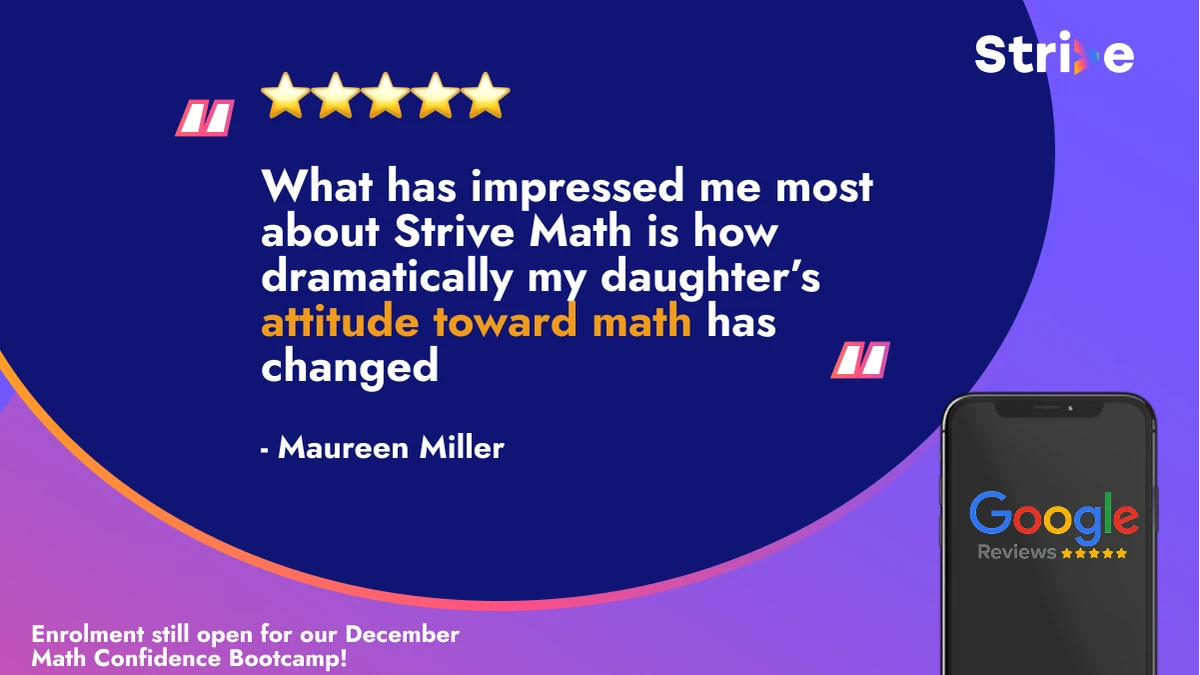
When a teacher who works with math education every day chooses your programme for her own daughter, it means something. Maureen Miller teaches internationally. She sees quality math education from multiple angles: as an educator who knows what rigorous instruction looks like, and as a parent who knows what her daughter actually needs.
What she shared about her daughter's experience with Strive Math stopped us in our tracks:
"What has impressed me most about Strive Math is how dramatically my daughter's attitude toward math has changed since joining. The coding-based sessions provide a low-pressure, supportive environment where she can explore concepts, spiral content, and solve problems creatively, without the stress she used to feel."
"I've watched her confidence grow as she's begun to see math as something she can play with, question, and enjoy. These experiences have helped her develop not only stronger problem-solving skills but also a genuine curiosity and resilience that extend beyond the classroom."
What Changes First: Mindset
The shift Maureen describes, from stress to play and from anxiety to curiosity, doesn't happen through drilling procedures or rushing through curricula. It happens in a specific kind of environment, and it's not easy to engineer.
Students who carry math anxiety into a session are protecting themselves. They've learned, through enough experiences of getting things wrong, to minimise exposure. They do the minimum to avoid looking confused. They rush through homework to be done with it. They don't ask questions because questions reveal that they don't understand something.
That protective instinct makes sense as a survival strategy. But it prevents exactly the kind of engagement that builds real understanding.
What a Low-Pressure Environment Actually Requires
"Low-pressure" is easy to say and hard to create. In Strive Math's approach, it starts with the structure of the sessions: coding-based, exploratory, and designed around problems that don't have a single right path through them.
When a student is building something, whether writing a programme that plots a graph or creating a simulation that models a real-world pattern, there's no "wrong answer" in the same way a test question has one. There are things that work and things that don't. The student tries, sees what happens, adjusts. The feedback comes from the programme, not from a mark on a page.
That structure changes the emotional experience of being stuck. Stuck means something to debug, not something to be ashamed of. The problem is still hard. But the relationship to the difficulty is different.
Maureen describes exactly this: her daughter now sees math as something to "play with, question, and enjoy." That's not a soft outcome. It's the foundation for every difficult concept that comes later.
What Resilience Beyond the Classroom Looks Like
The phrase "resilience that extends beyond the classroom" is the part of Maureen's review that matters most. Problem-solving skills are useful in math class. Curiosity and resilience are useful everywhere.
Students who develop the habit of engaging with hard problems, who've learned that confusion is temporary and that persistence pays off, carry that habit into every subject. It extends into how they handle difficulty at work, in relationships, and in any domain where the answer isn't immediately obvious.
That's the outcome Strive Math is built around: not just stronger scores, but a different relationship with challenge itself.
Thank you, Maureen, for trusting us with your daughter's math journey. Reviews like this remind us exactly why we do this work.
